Start with a stocktake
Pull everything out of your current kitchen cupboards and count it. Pots, pans, crockery, glassware, baking trays, mixing bowls, the lot. Most people are surprised by how much they own once it's all laid out on the bench.
- Group items by type so you can see where the bulk really sits
- Set aside anything chipped, unused or duplicated so it's not factored into your new storage needs
- Measure your biggest pieces, since an oversized roasting dish or stand mixer bowl could dictate shelf height
Count your gadgets too
Appliances deserve the same treatment as your cookware. Toasters, blenders, air fryers, (and the bread maker you used twice!): they all need a home.
- List every appliance you use regularly and those you keep for occasional use
- Consider an appliance cupboard with a bench-height shelf, so gadgets can be tucked away and plugged in without being constantly lifted in and out
Choose deep drawers over cupboards
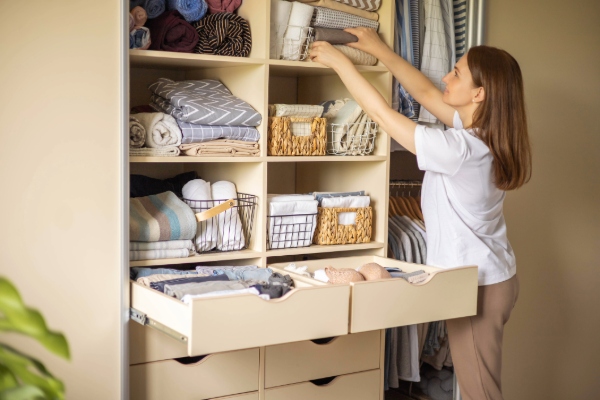
Deep drawers are far easier to live with than low cupboards, since you can see and reach everything at a glance instead of crouching and digging through the back.
- Ideal for pots, pans, small appliances and pantry staples
- Reduce the need to bend or kneel to reach items at the back
- Work well with drawer dividers to keep items from sliding around
Plan storage near the dishwasher
Where you store crockery, serving dishes and cutlery matters more than most people expect. Keeping them close to the dishwasher makes unloading easier.
- Position everyday plates, bowls and cutlery in cabinetry directly above or beside the dishwasher
- Keep glassware nearby too, if it's part of your daily unload
Take your cupboards to the ceiling
Overhead cupboards that stop short of the ceiling leave a gap that usually collects dust rather than doing anything useful. Extending them all the way up puts that space to work.
- Use the top shelf for items you rarely reach for, like special occasion serving ware
- A small step stool solves the access issue for the top shelf
- Ceiling height cabinetry also gives the kitchen a neater, more finished look
Swap corner cupboards for corner drawers
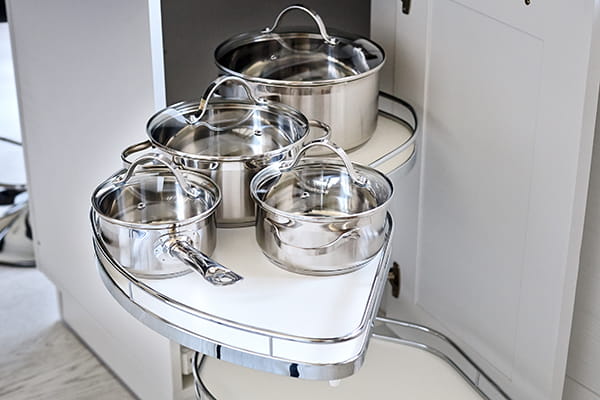
Corner cupboards are notorious for wasted space and awkward reaching. Corner drawer units solve this by pulling everything out towards you instead of making you climb in after it.
- Corner drawers make full use of an area that's otherwise hard to access
- They're particularly useful for pantry items, baking trays and larger pots
- Worth discussing with your kitchen designer early, since corner units need to be planned into the cabinetry layout from the start
Add a pull-out pantry
A narrow pull-out pantry, sometimes called a larder unit, fits into gaps as slim as 150mm and holds far more than that width suggests, since shelves run down both sides.
- Well suited to tight kitchens where a full pantry room or walk-in isn't possible
- Great for tinned goods, oils, spices and packet staples, since everything slides forward for easy viewing
- Positioned near the fridge or prep bench, it keeps cooking ingredients within a step or two of where you'll use them
Use vertical dividers for trays and boards
Baking trays, chopping boards and cooling racks are awkward to stack flat, since the item on the bottom is always the one you need. Vertical dividers fix this by storing them on their edge instead.
- Fit dividers into a cupboard or a slim pull-out beside the oven
- Keeps trays and boards separated so they don't scratch each other
- Frees up flat shelf space elsewhere for items that do need to be stacked
Sort out bin and recycling storage early
A pull-out bin unit tucked into a cabinet keeps general waste, recycling and FOGO separated and out of view, rather than left as a freestanding bin taking up floor space.
- Position it near the sink or prep area, since that's where most scraps are generated
- Multi-compartment units make separating recycling from general waste much easier day to day
- Worth confirming bin dimensions with your cabinet maker, since councils vary in what they collect and how
Create a dedicated zone near the cooktop
The area right beside your cooktop gets used constantly, so it's worth planning specific storage there rather than leaving it to whatever fits.
- A narrow pull-out for oils, spices and cooking utensils keeps everything within arm's reach while you're cooking
- A rail with hooks can hold frequently used utensils without cluttering a drawer
- Heatproof surfaces nearby give you somewhere to rest a hot pan lid or spoon
Get professional input
Speak to your local kitchen renovations expert who will be able to offer help and advice about making the most of the space you have for storage.